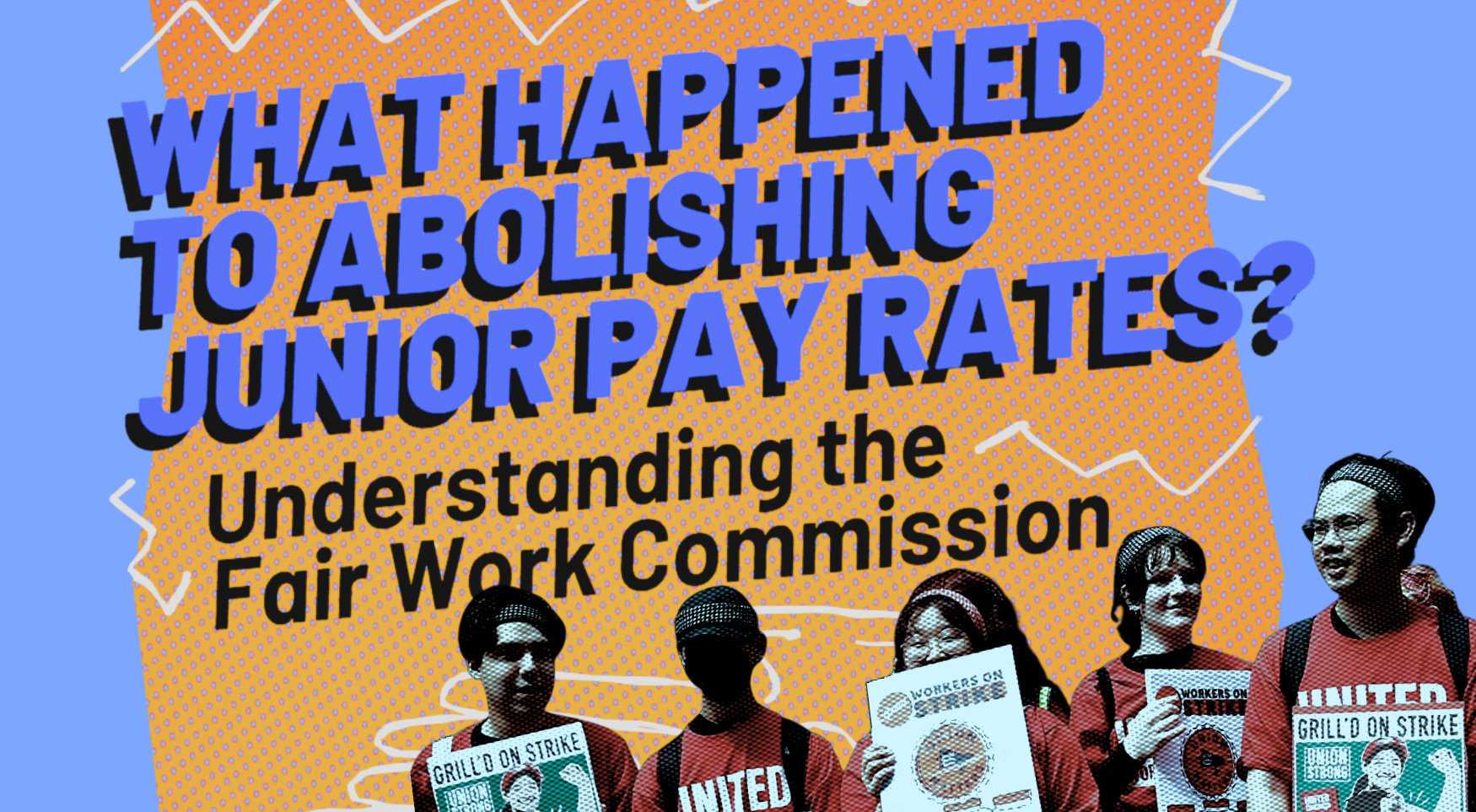
In March this year, the Fair Work Commission decided to partly abolish junior pay rates for retail, fast food, and pharmaceutical workers.
Until now, workers under 21 years old were legally paid beneath the adult minimum wage – this is why many young people in their first jobs are paid $14/hour, while an adult doing the same work receives over $25/hour. However, the removal of junior pay rates does not apply to workers under 18, and workers have to be with the same employer for at least six months to receive the full minimum wage.
Within the union movement, there has been criticism of this decision. RAFFWU’s Josh Cullinan said, ‘These rotten low junior rates are the means to job insecurity because bosses will churn workers to keep them ever younger… the simple solution is to abolish all junior rates.’
This ruling is also yet to be implemented, with the Fair Work Commission website stating that “changes could start from 1 December 2026”. RAFFWU indicates that there will be a long four year phase-in, which means many workers receiving junior pay rates today are unlikely to see the benefits of this change.
Background to the decision
Junior pay rates are embedded in the industrial awards which set the minimum employment conditions for specific industries. Reduced wages for young workers are particularly prominent in the retail, fast food, and pharmaceutical sectors, where bosses rely on cheap young workers to rake in bigger profits.
In public, bosses dress up junior pay rates with language of empowerment, saying that junior rates ‘help’ young people get jobs and encourage their skill development. However, the way in which employers (such as those in fast food) scramble for the cheapest workers possible, going so far as to neglect their long-term older employees, should make clear that they have anything but benevolent intentions.
Although Fair Work’s decision has some benefits, we should be critical of the Commission, who has acted against young workers’ interests. For instance, in 2017, the Commission cut penalty rates for the very same workers in retail, fast food and pharmacies that it now seeks to help, directly reducing their take home pay. While new laws prevent the Commission from cutting penalty rates again in future, there are other ways that the Commission protects bosses and screws over workers, including by hindering workers who try to take industrial action like strikes.
Even with the change to junior pay rates, it is clear that the Fair Work Commission is playing a balancing game. While young workers have some gains, the Commission is limited by its role as an arbitrator that must encourage co-operation between workers and bosses. This is despite the inherent conflict of interests between the two – workers want to be paid for their work and be treated with dignity, whereas bosses want ever-growing profits, which require low wages and poor work conditions.
Where to from here?
Of course, junior pay rates are only part of the picture in young worker exploitation. Workers under 18 years old continue to largely be denied superannuation for no real reason but making them even cheaper to employ. Additionally, workers in apprenticeships continue to face abuse and unsafe working conditions, and young workers as a whole have their wages stolen at high rates, despite wage theft being nominally illegal.
These issues are even worse for migrants. Those on student visas have a limited number of hours they can work, which means that they often struggle to earn enough money legally to meet their living needs. As a result, they are pushed into precarious work in breach of their visas, allowing bosses to pay them even less and sometimes threaten them with deportation.
This rife exploitation is not accidental. It is an intentional feature of labour law, designed to make life easier and more profitable for bosses. The law either expressly allows for the exploitation of young workers or is otherwise designed in a way that facilitates it.
As a result, a body like the Fair Work Commission, which is designed to apply the law and balance the interests of workers and bosses, can never end exploitation, only moderate some of its worst excesses. How could the Commission prevent the exploitation of young workers, when the law deems it to be acceptable? How could it protect migrants when the caps on working hours are designed to make them easily exploitable?
The solution to these issues is to look beyond small legal wins. While the Fair Work Commission may help workers on occasion, it will more often let them down and side with bosses. Instead of resting our fate in the hands of the Commission, we need to build strong relationships at our workplaces and push for the rights of young workers.
This could look like workers on the job talking and planning together to refuse unsafe work conditions. It could be pushing in a new enterprise bargaining agreement for junior pay rates to be abolished. Or it could be workers walking off the job together to pressure bosses to do what’s right. When we work together with our coworkers, what we can achieve is far greater than the concessions the Fair Work Commission will ever grant, and we have much greater control over what happens.
But building power with coworkers is not an easy task, nor one done overnight. Migrants Building Power is a network of workers on and off visa working together to develop skills and connections to organise our workplaces. If you want to learn more, get in touch with us.